


The Coffee Trade: Fair, Direct or Transparent?
Coffee perks up many sleepy-headed Americans each morning, but too few are sufficiently roused to investigate the economic struggles of those who grow and harvest it.
U.S. consumers will spend a projected $13.6 billion for coffee in 2016, largely unaware that a small fraction trickles down convoluted supply chains to 25 million “smallholder” farmers, who rely largely on family labor to tend to their small plots of land and produce four-fifths of global output. Some growers receive less than $1 for a pound of green (unroasted) coffee that may cost $20 a bag roasted and generate $150 at a coffee bar.
A Colombian family with five acres can produce about two tons of green coffee per year but net a mere $195 per month after expenses. That’s too little to improve wages, safety, or environmental practices, much less feed, clothe, and educate children. The result is that the next generation leaves for city jobs and production shifts to plantations, where larger environmental and labor issues persist.
For a half-century, international trade pacts, national laws, and nongovernmental organizations have sought better farming conditions. “Fair trade” programs establish standards, certify compliance, and guarantee farmers a minimum price to blunt market and weather downturns. Label certifications aim to drive concerned consumers to fair-trade products.
Since the 1990s, specialty coffee roasters seeking higher-quality flavors have bypassed commodity market middlemen to source single-origin beans from farmers. This “direct trade” model pays farmers more, but also bypasses fair-trade certifications, drawing scorn from fair traders, who say it supports quality for consumers but not social justice for growers.
Direct traders argue farmers can earn more through superior coffee than fair-trade logos. They emphasize partnerships to help farmers improve quality. Recently, some have begun moving toward a new “transparent trade” model that offers consumers a clear picture of what portion of their coffee spending goes back to growers.
-
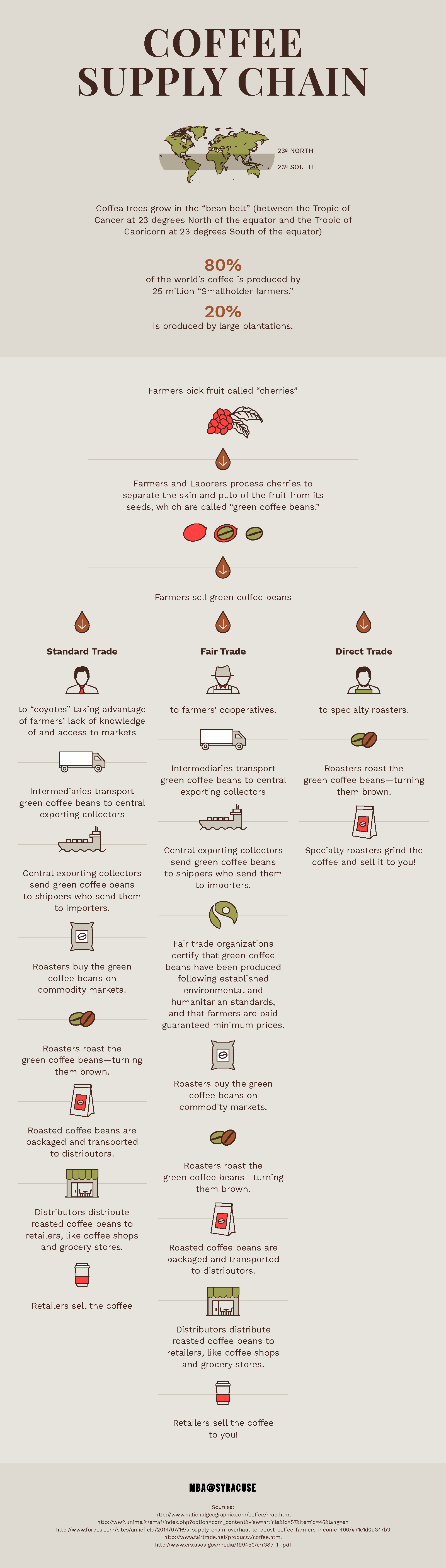
- Coffea trees grow in the “bean belt” (between the Tropic of Cancer at 23 degrees North of the equator and the Tropic of Capricorn at 23 degrees South of the equator)
- 80% of the world’s coffee is produced by 25 million “Smallholder farmers.”20% is produced by large plantations
- Farmers pick fruit called “cherries&rdquo
- Farmers and Laborers process cherries to separate the skin and pulp of the fruit from its seeds, which are called “green coffee beans.”
Standard Trade Fair Trade Direct Trade Farmers sell green coffee beans to “coyotes” taking advantage of farmers’ lack of knowledge of and access to markets.Farmers sell green coffee beans to farmers’ cooperatives.Farmers sell green coffee beans to specialty roasters.Intermediaries transport green coffee beans to central exporting collectorsIntermediaries transport green coffee beans to central exporting collectorsRoasters roast the green coffee beans—turning them brown.Central exporting collectors send green coffee beans to shippers who send them to importers.Central exporting collectors send green coffee beans to shippers who send them to importers.Specialty roasters grind the coffee and sell it to you!Roasters buy the green coffee beans on commodity markets.Fair trade organizations certify that green coffee beans have been produced following established environmental and humanitarian standards, and that farmers are paid guaranteed minimum prices.Roasters roast the green coffee beans—turning them brown.Roasters buy the green coffee beans on commodity markets.Roasted coffee beans are packaged and transported to distributors.Roasters roast the green coffee beans—turning them brown.Distributors distribute roasted coffee beans to retailers, like coffee shops and grocery stores.Roasted coffee beans are packaged and transported to distributors.Retailers sell the coffee to you!Distributors distribute roasted coffee beans to retailers, like coffee shops and grocery stores.Retailers sell the coffee to you!MBA@Syracuse
Sources:
http://www.nationalgeographic.com/coffee/map.html
http://ww2.unime.it/emaf/index.php?option=com_content&view=article&id=57&Itemid=45&lang=en
http://www.forbes.com/sites/annefield/2014/07/16/a-supply-chain-overhaul-to-boost-coffee-farmers-income-400/#71c1d0d347b3
http://www.fairtrade.net/products/coffee.html
http://www.ers.usda.gov/media/199450/err38b_1_.pdf